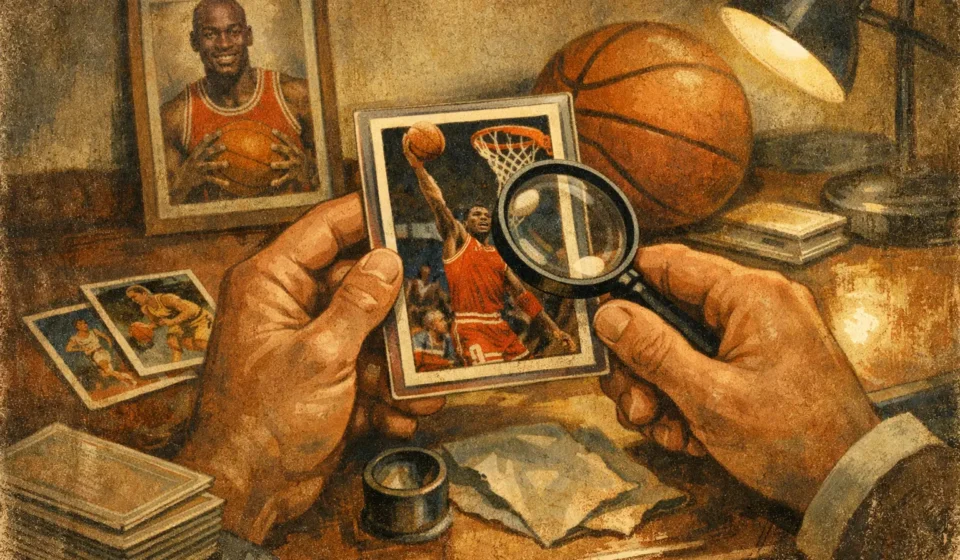

The 1986-87 Fleer #57 Michael Jordan rookie card is one of the few sports cards recognized immediately by collectors, casual fans, and gift buyers alike. The familiar red-and-yellow action photo, the Fleer Basketball design, and Jordan’s name on the front have made it a centerpiece card across raw, PSA, BGS, and SGC markets. That recognition also means buyers need to be precise: condition, authenticity, print quality, and the exact card being offered can change the buying decision fast.
The Card Most Collectors Mean
When collectors say Michael Jordan rookie card, they usually mean the 1986-87 Fleer Basketball #57. It is Jordan’s mainstream rookie card, issued in Fleer’s landmark 132-card basketball set after the NBA’s long gap without a major national trading-card release.
Card #57 shows Jordan in a Chicago Bulls uniform rising toward the basket, framed by a bold red, white, yellow, and blue border. The back identifies him as Michael Jordan and lists his 1984-85 and 1985-86 statistics. Those details are basic, but they matter when comparing a listing photo with the card in hand.
The card’s place in hobby history is the main reason it remains a market-defining basketball collectible. It sits alongside rookie cards of fellow Hall of Famers including Patrick Ewing, Hakeem Olajuwon, Karl Malone, Chris Mullin, and Charles Barkley, but Jordan #57 is the card that drives the set. A clean, authenticated example has broad demand whether the buyer is building a vintage basketball collection, buying a major sports gift, or adding a recognizable long-term hold.
Jordan Fleer #57 vs. Earlier Star Cards
The Fleer #57 is not Jordan’s earliest licensed card. Jordan appeared in 1984-85 Star Company releases before Fleer issued its 1986-87 set. The 1984-85 Star #101, often called the Star Rookie, is a significant early Jordan issue and commands serious collector interest.
Still, Star cards and Fleer #57 serve different collecting lanes. Star Company cards were distributed in team bags and have a more specialized authentication history. The Fleer #57 is the widely accepted traditional rookie card in mainstream hobby language. Neither choice is automatically better. A buyer focused on Jordan’s earliest professional card may prefer Star, while a buyer looking for the iconic basketball rookie card usually starts with Fleer #57.
Another item that causes confusion is the 1986-87 Fleer Michael Jordan sticker, card #8 in the Fleer sticker set. It is a desirable Jordan collectible from the same season, but it is not the standard Fleer #57 rookie card. A listing title that says “Jordan rookie” is not enough. Confirm the set, card number, and front-and-back photos before treating an item as Fleer #57.
Condition Drives the Difference
A raw Michael Jordan Fleer rookie can look appealing in a single front photo, yet the details that separate a sharp copy from a lower-grade example are often small. Centering is the first major checkpoint. The white border should be even enough to support the grade and asking price. A card with noticeably heavier border width on one side may still be a solid collector copy, but it should not be priced like a strong PSA 9 or PSA 10 candidate.
Corners are equally important. The black areas of the design can make minor corner wear easier to spot, while the white border can reveal softening, fraying, or chipping. Review all four corners, not only the two shown most clearly in a listing image.
Surface condition matters on this issue because print marks, scratches, wax residue, and small dents can appear even on cards that present well from a distance. Check for:
- Print dots, fish-eyes, or roller marks in the colored background
- Chipping along the dark print areas and card edges
- Creases, indentations, or surface wrinkles under reflected light
- Staining, discoloration, or residue on the front or back
The back deserves the same attention as the front. Off-center printing, edge wear, and surface damage can be easier to see around the stat box and text. For an Ungraded / Raw card, clear scans or photos of both sides are more useful than a vague condition label such as “near mint.”
What a Grade Tells You, and What It Does Not
A professionally graded Fleer #57 offers a defined condition opinion and an encapsulated holder, which can reduce uncertainty for buyers. PSA is especially common for this card, but BGS and SGC examples are also actively collected. A PSA 8, SGC 8, BGS 8.5, or other comparable grade should not be treated as identical without checking the card’s presentation, subgrades where available, and current asking price.
PSA 10 examples command attention because high-grade supply is limited relative to the enormous demand for the card. That does not mean every collector needs to chase one. PSA 7 and PSA 8 copies often provide strong eye appeal and authentic vintage presence at a more practical entry point. The right grade depends on whether the card is intended for a display, a complete Fleer set, a Jordan collection, or a high-grade investment portfolio.
Grading also does not replace basic due diligence. Inspect the holder for cracks, label inconsistencies, or signs of tampering. Review the certification details provided with the listing and make sure the player, year, set, card number, and grade match the slab photos. If the front image is unclear, the holder is damaged, or the listing lacks usable photos, waiting for a better example is usually the cleaner move.
Authenticity Is a Core Buying Requirement
The popularity of the 1986-87 Fleer Jordan #57 has led to reprints, counterfeit cards, altered cards, and misleading listings. Some are clearly labeled as reproductions. Others may use broad phrases such as “Jordan rookie style,” “custom,” or “reprint” where the important language is easy to miss.
A real 1986-87 Fleer #57 should have the correct Fleer design, card number, statistics, and print characteristics for the original release. But photo-based comparison alone is not a complete authentication method. High-value raw examples carry more risk because trimming, recoloring, restoration, and counterfeiting may not be visible in low-resolution images.
For buyers who want the lowest-friction route, a card already authenticated and graded by PSA, SGC, or BGS can be the practical choice. For raw-card buyers, seller history, clear images, accurate set identification, and a price that makes sense for the stated condition all matter. A raw card offered at an unusually low price is not automatically a bargain. It can be a lower-grade copy, a reprint, or an item that needs much closer review.
A Practical Listing Checklist
Before purchasing, compare the listing against the card record rather than relying on the headline alone. Confirm that it identifies 1986-87 Fleer Basketball and card #57, then check whether the condition is listed as Graded or Ungraded / Raw. For graded examples, verify the grading company and numeric grade. For raw examples, look closely at centering, corners, edges, surface, and the back of the card.
Also separate the asking price from the card itself. Two listings may both be PSA 8 copies, yet one can have cleaner centering, better eye appeal, a newer holder, or a more realistic price. The same applies to raw cards, where an accurately described EX to NM copy may be a better purchase than a supposedly mint card shown with limited photos.
At RookieCards.net, a structured card record helps keep those purchase details together: athlete, year, manufacturer, set, card number, grade or raw status, condition, and current asking price. That format is useful when several Jordan listings look similar but are actually different issues, grades, or quality levels.
Build the Purchase Around Your Goal
The best Michael Jordan Fleer rookie is not always the highest-grade card available. A collector building the 1986-87 Fleer set may prioritize a presentable PSA 7 or SGC 7. A Jordan-focused display collector may choose a centered raw copy with strong color. A buyer targeting top-tier graded cards may hold out for a PSA 9 or PSA 10 with clean eye appeal and a price that fits the budget.
Take a closer look at the exact card, not just the Jordan name on the label. The right copy is the one whose set, card number, authentication, condition, and asking price all line up with the reason you wanted it in the first place.